
.
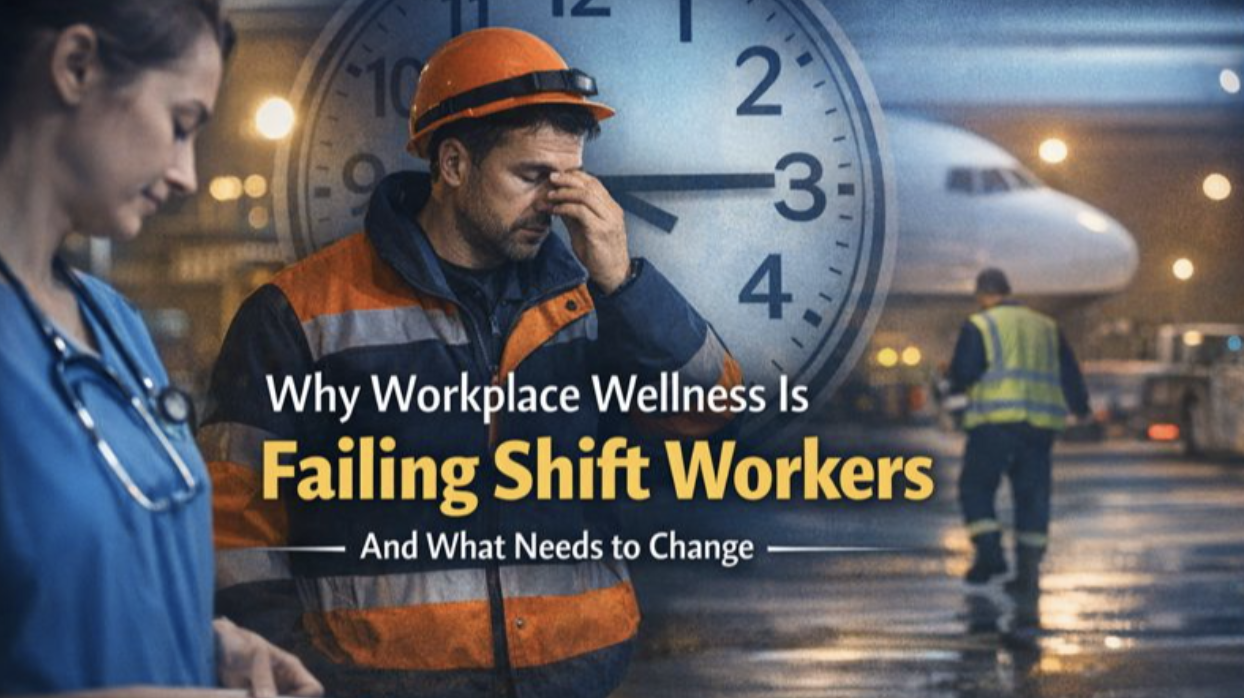
Workplace wellness has become a priority for many organisations – and rightly so. Healthier employees are safer, more productive, and more engaged.
But there’s an uncomfortable truth we don’t talk about enough:
Most workplace wellness initiatives were never designed for shift workers.
They were designed for a 9–5 workforce — and then applied universally.
For industries that operate around the clock — transport, logistics, healthcare, emergency services, mining, aviation — this mismatch has real consequences.
The Hidden Assumption Behind Most Wellness Programs
Look closely at most corporate wellness strategies and you’ll see an unspoken assumption:
That employees:
- Sleep at night
- Eat during the day
- See morning sunlight
- Follow predictable routines
- Recover on weekends
Shift workers don’t live in that world.
Their schedules routinely disrupt:
- Sleep timing and duration
- Light exposure
- Meal timing
- Hormonal rhythms
- Nervous system regulation
And yet we continue to apply wellness strategies that assume biological stability — in roles that actively erode it.
This Isn’t a Motivation Problem. It’s a Biology Problem.
When shift workers struggle with fatigue, weight gain, high blood pressure, mood changes, or poor sleep, the narrative often becomes one of personal responsibility.
“Better choices.” “More discipline.” “Improve sleep hygiene.”
But these challenges are not moral failings.
They are predictable biological responses to circadian disruption.
The human body is governed by internal clocks — circadian rhythms — that regulate:
- Blood pressure
- Metabolism
- Alertness
- Hormone release
- Body temperature
Shift work doesn’t just change when someone works. It changes when the body is asked to perform against its natural rhythms.
Ignoring this reality doesn’t make the risks disappear — it simply shifts them downstream into:
- Increased health claims
- Higher absenteeism
- Safety incidents
- Reduced cognitive performance
- Early burnout and workforce attrition
Why “Wellness Extras” Aren’t Enough
Step challenges, mindfulness apps, healthy snacks, and gym discounts can all have value — but for shift workers, they’re often insufficient on their own.
Why?
Because timing matters as much as behaviour.
For example:
- Exercise at the wrong time can worsen sleep
- Eating at the wrong biological hour can elevate blood glucose and blood pressure
- Light exposure at the wrong time can suppress melatonin and delay recovery
- Caffeine used without circadian awareness can deepen fatigue cycles
Without a time-based framework, even “healthy” behaviours can backfire.
The Missing Layer: Chrono-Informed Workplace Wellness
The next evolution of workplace wellness must move beyond what employees do — and begin addressing when they do it.
Chrono-informed wellness considers:
- Light exposure as a performance and recovery tool
- Sleep timing, not just sleep duration
- Meal timing to support metabolic health
- Strategic movement for alertness or wind-down
- Nervous system regulation across rotating rosters
This isn’t about perfection. It’s about reducing biological friction in demanding roles.
When organisations begin aligning wellness strategies with human biology under shift conditions, the outcomes extend well beyond individual health:
- More stable energy levels
- Improved decision-making
- Reduced error rates
- Better recovery between shifts
- Stronger workforce retention
A Strategic Opportunity for Employers
Shift workers are essential. They keep communities safe, goods moving, and systems functioning 24/7.
Yet many organisations are still applying wellness models that unintentionally disadvantage them.
There is a significant opportunity here — not just for health outcomes, but for:
- Safety performance
- Productivity
- Culture
- Long-term workforce sustainability
The question for organisations is no longer: “Do we offer wellness?”
It’s: “Is our wellness strategy designed for the realities of shift work?”
Because when wellness works with biology instead of against it, everyone benefits.


0 Comments